
Stories·October 25, 2026
Rubinrot, 1959: a Convertible D and the papers that kept its story
A Park Avenue importer, a coachbuilder in Heilbronn and a model that lasted thirteen months. The story of the 356 Convertible D, told through one ruby-red 1959 car, its Kardex, its $4,300 invoice and a letter written in 1963.
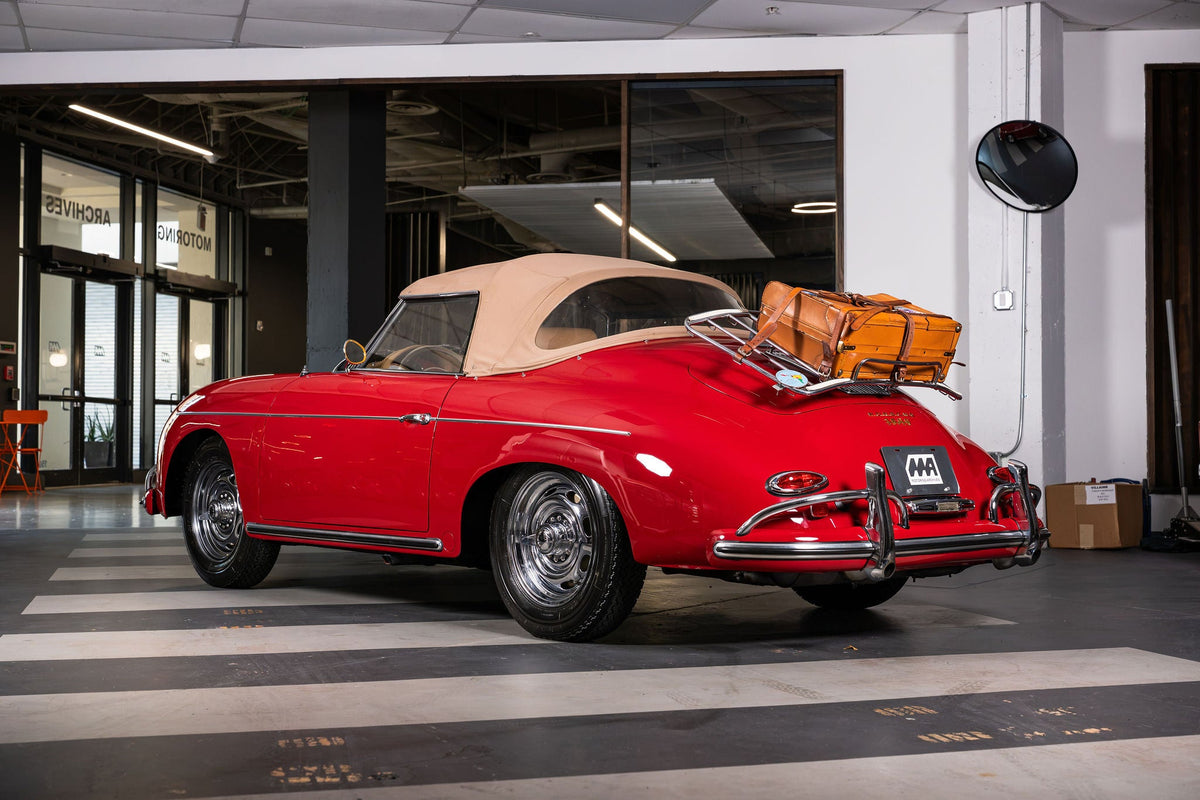
Most old cars have lost their stories, because nobody kept the paper. This one kept almost all of it: the factory card that records how it was built, the invoice from the day it was sold, and a letter written in 1963 by someone who knew it from its first 122 miles. But to understand why it exists at all, you have to start on Park Avenue.

Chapter one · New York, 1950s
The Baron of Park Avenue
Max Hoffman was a Viennese émigré with a showroom on Park Avenue and a nickname to match: the Baron of Park Avenue. In 1950 he brought the first three Porsche 356s into the United States, and for most of the decade he was Porsche's man in America. He also had firm ideas about what Americans would buy.
What they wanted, he told Stuttgart, was a Porsche for under three thousand dollars.Max Hoffman's brief
The answer, in 1954, was the Speedster: a stripped, low-screened 356 that sold in New York for $2,995, the cheapest Porsche there has ever been. Hoffman made the tachometer and heater optional to hit the price, and borrowed the name from a Studebaker. California loved it. Almost everywhere else, it was simply too spartan.

July 1958. Porsche writes to its importers: the Speedster has not been well received outside the American West.
August 1958. Its replacement arrives. The Convertible D, the D for Drauz, the coachbuilder in Heilbronn that built every body.
A car you could live with. A taller windscreen. Wind-up glass windows instead of clip-in side curtains. A better top, a kinder cabin, and teardrop tail lamps in place of the old beehives.
September 1959. Production ends. Thirteen months, 1,331 cars, and the 356 B Roadster takes its place.

Chapter two · The Kardex
A birth certificate on a card
Porsche kept a Kardex, a factory record card, for every car it built. This one survives, and it reads like a birth certificate.
Chassis number 086219. Engine number 83 701, the Type 616/2 1600 Super, 1,582 cc and 75 hp. Gearbox number 23 536. Ignition lock K 145, with key 19. Colour: rubinrot, over Kunstleder braun, brown leatherette. Accepted on 17 April 1959. Dealer: Hoffman, New York.
Chromed centre-lock wheels. Reclining seats. Head rolls. An electric clock.
That is the Sonderausführung, the special equipment, and it is where this car stops being ordinary. In 1959 it was a carefully optioned car, built for someone who knew exactly what they wanted.

On the dashboard
The electric clock is one of the extras on the Kardex, still in its place in the dash sixty-seven years later.
Next to it, the brown leatherette the card specifies, and the reclining seats that were a long way from the Speedster's thin buckets.
Chapter three · 20 June 1959
$4,300, and a letter
Two months after the factory signed it off, the car was sold. The invoice from County Cars Inc. survives, dated 20 June 1959, for $4,300.00. It is a rare thing to hold: the actual piece of paper from the day someone first took this car home.
Then there is the letter. Signed and dated 4 November 1963, it runs through the car's life from its first 122 miles. It also passes on a claim from the salesman who sold it: that this very car stood at the New York Auto Show in the spring of 1959.
The New York Auto Show claim comes from a letter written in 1963 and has not been independently confirmed.


Chapter four · Heilbronn to South Miami
Numbers that match
The detail a collector looks for first is a small plate on the door pillar. The Drauz body plate on this car reads Nr. 86219, the same as the chassis. Body and chassis have stayed together since they left Heilbronn.
From the archive
Five things to know about this car
- Its Kardex survives, recording chassis 086219, engine 83 701, gearbox 23 536, and ignition lock K 145 with key 19.
- It left the factory in April 1959, finished in ruby red (rubinrot) with a brown interior, bound for Max Hoffman's dealership in New York.
- It was ordered with extras: chromed centre-lock wheels, reclining seats, head rolls and an electric clock.
- Its first invoice survives: County Cars Inc., 20 June 1959, $4,300.00.
- Body and chassis match. The Drauz plate on the door pillar reads Nr. 86219, the same as the chassis.

The car today.
The car presents repainted, refreshed and mechanically sorted, with an electric fuel pump fitted. The odometer reads 38,897 miles; with no records between July 1963 and today, that figure is not represented as original. Even so, sixty-seven years on, the Kardex, the invoice and the letter tell more of its story than most cars of its age ever could.
For sale · Sunset Showroom
See it in person
This car is for sale and on display at our Sunset Showroom, 5701 Sunset Drive, South Miami. Mon–Fri 9–6 · Sat 8–1.