
Stories·October 25, 2026
Number 54: a 911 GT3 R and its 2017 IMSA season
A customer racing car from Weissach, a five-time champion team changing class, and a season from Daytona to Petit Le Mans. The story of CORE autosport's number 54 Porsche 911 GT3 R, told by chassis number.
On 18 November 2016, Porsche Motorsport signed off a data sheet for chassis 199503. It listed an engine number, a gearbox number, a roll cage, a fuel cell and a kerb weight of 1,230 kilograms. Seven weeks later the car was on the banking at Daytona, wearing the number 54.

Chapter one · 2015
A customer car from Weissach
Porsche does not only race its own cars. It builds racing cars for customers, teams that buy a car, run it themselves and go out to beat everyone else, often including other Porsches. In May 2015 it unveiled the customer car for the new GT3 era: the 911 GT3 R, based on the 991 generation.
It was priced at 429,000 euros before tax. Orders opened that May and the first cars went to customers in December 2015. Its engine came almost unchanged from the 911 GT3 RS road car: a 4.0-litre naturally aspirated flat-six of 3,996 cc, producing 493 horsepower before any restrictor, driving through a sequential six-speed gearbox shifted by paddles.
It went straight to work. At the Rolex 24 At Daytona in January 2017, a 911 GT3 R won the GTD class by 0.293 seconds. This car was in the same race.

Chapter two · What a GT3 R is
One rulebook, many makers
The GT3 in its name puts the car in a particular kind of racing. GT3 is a set of rules for production-based racing cars, and almost every maker of fast cars builds one: Ferrari, Lamborghini, Mercedes-AMG, BMW, Audi, Acura, Aston Martin. They are very different machines, so the organisers balance them with air restrictors, weight and ride height, known as the Balance of Performance, to make them race each other on equal terms. In IMSA that class is called GT Daytona, or GTD.
GT3 cars are built to be bought. Porsche sells them to private teams, who often pair a professional driver with a paying amateur. That puts the GT3 R in the middle of Porsche's racing family: above the 911 GT3 Cup, which races only against other Porsches, and below the factory 911 RSR, which Porsche runs itself.
A racing car Porsche builds to sell.

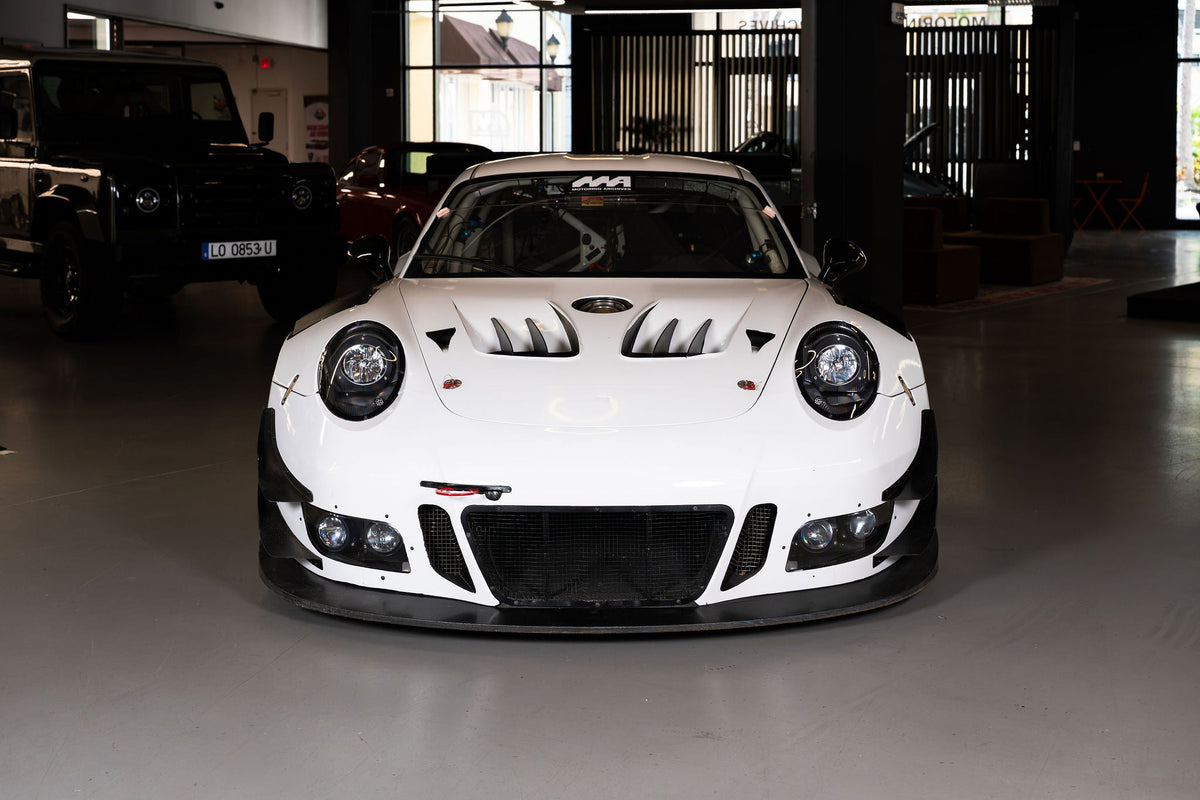
A road car's bones. The aluminium-steel body comes from the 911 GT3 RS. The roof, doors, front and rear covers, wheel arches and wing are carbon fibre, and every window, the windscreen included, is polycarbonate.
A radiator in the nose. Borrowed from the 911 RSR, the single radiator sits in the middle of the front, lower and better protected, and breathes out through the louvres in the bonnet.
A two-metre wing. Forty centimetres deep, balanced by vents in the front wheel arches for downforce at the nose.
Brakes for endurance. 380 mm discs with six-piston calipers in front, 372 mm with four pistons behind, racing ABS and traction control, and a brake-balance bar the driver adjusts from the seat.
Built to be serviced fast. Centre-lock wheels, four built-in air jacks, a 120-litre safety fuel cell and removable doors. There is an escape hatch in the roof.
Chapter three · CORE autosport
A championship team changes class
CORE autosport came to GTD with a record. Between 2011 and 2015 it won five straight IMSA Prototype Challenge team titles and four drivers' titles. It was also the team that ran Porsche's own factory effort in the GT Le Mans class in IMSA. With Prototype Challenge on its way out, it switched to GTD for 2017, and it chose Porsche.
Team owner Jon Bennett and Colin Braun, in a 911 GT3 R.
Jon Bennett, the team's owner, and Colin Braun had driven together in Prototype Challenge. For 2017 they moved into the 911 GT3 R, joined for the endurance races by Niclas Jönsson and, at Daytona, by Porsche factory driver Patrick Long.


Chapter four · 2017
One season, by chassis number
On a race car, history is only as good as the paperwork that ties it to the chassis. Seven entries are recorded for CORE autosport's number 54 in 2017, and five of them carry this car's chassis number in the timing database.

It started at the Roar Before the Rolex 24 on 8 January. At the race itself, on 29 January, Bennett, Braun, Jönsson and Long started 53rd; the car did not finish. At the Sebring test in February it was the fastest GTD car. At the Twelve Hours of Sebring in March it retired again. Later in the year Bennett and Braun finished 16th at VIR from 23rd on the grid, 21st at Laguna Seca from 31st, and, with Jönsson, 21st at Petit Le Mans from 38th.

Daytona, Sebring, VIR, Laguna Seca, Road Atlanta.
Chapter five · The data sheet
Built for endurance racing

Ordered for North America. The FIA endurance package, the IMSA package, catalytic converters, illuminated race numbers and a heated polycarbonate windscreen.
Every part numbered. Engine MA185 number HR 00 504, gearbox G91/73 number 2H 00 504, roll cage 18253, fuel cell 810753923.
Geared as delivered. Final drive 17/41, first gear 13/41, sixth 26/29, all recorded by Porsche Motorsport.

Carson, California
On 1 May 2017, between Sebring and VIR, Porsche Motorsport North America rebuilt the engine at its Carson workshop. The certificate records 37.1 accumulated hours and rebuild number one.
The car's own display records 39,698 kilometres in total. A race car has no odometer; this is what it reports itself.


From the archive
Five things to know about this car
- It raced the 2017 IMSA season as CORE autosport's number 54, from the Roar Before the Rolex 24 to Petit Le Mans.
- It was the fastest GTD car at the Sebring February test in 2017.
- Patrick Long drove it at Daytona, alongside Jon Bennett, Colin Braun and Niclas Jönsson.
- Its Porsche Motorsport data sheet survives, dated 18 November 2016, with every major serial number and a kerb weight of 1,230 kg.
- It comes with spares: two sets of spare wheels and a spare carbon body.

The car today.
It wears plain white now, its 2017 livery removed, with the Porsche Motorsport wheel and display, a full FIA cage, air jacks, fire suppression and driver cooling still in place. It is a race car only, sold on a bill of sale, and its FIA fuel cell certification ran out in August 2021. Nine years after Daytona, it is still the car on that data sheet.
For sale · Sunset Showroom
See it in person
This car is for sale and on display at our Sunset Showroom, 5701 Sunset Drive, South Miami. Mon–Fri 9–6 · Sat 8–1.