
Stories·October 25, 2026
One of 86: the 964 Turbo S Lightweight
In January 1992 a memo went round Porsche Exclusive. By November, 86 of the lightest, fastest 964 Turbos ever made had left Zuffenhausen. This is the story of that car, of the racing season behind it, and of one of the 86, restored in Germany and now in South Miami.
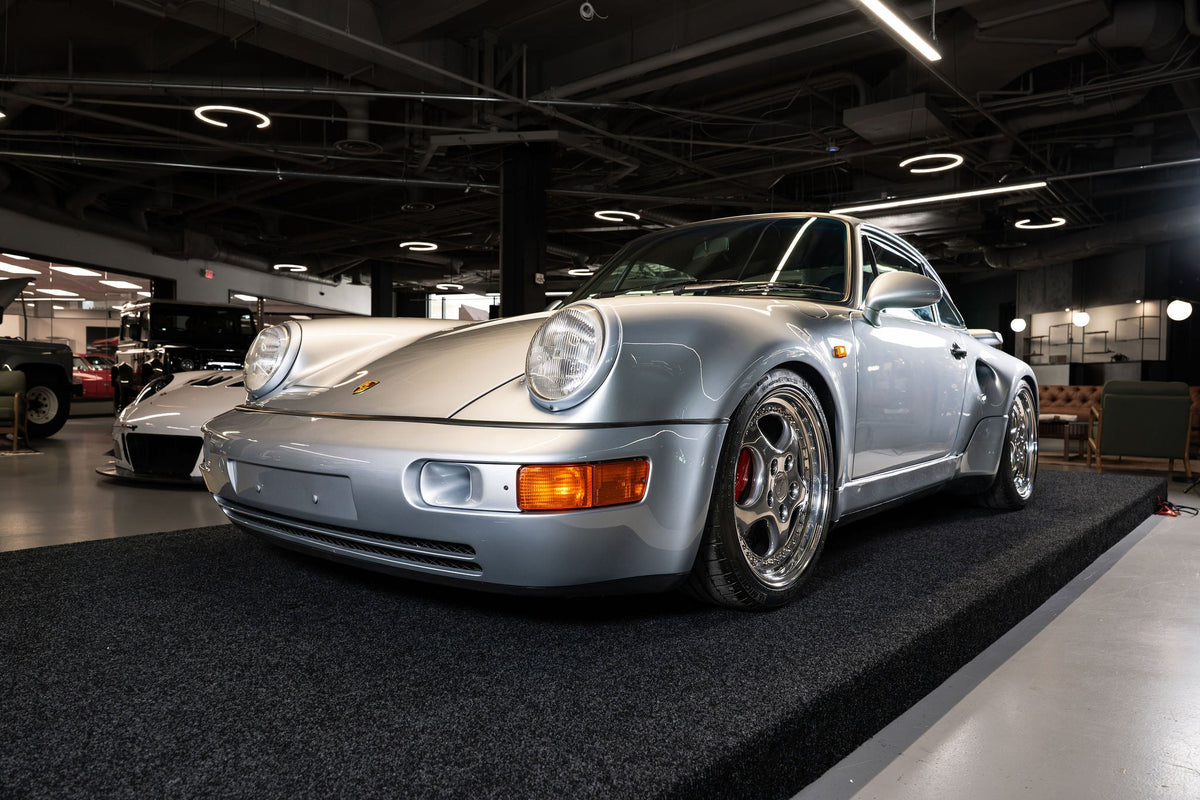
In January 1992, a man called Rolf Sprenger sat down at his desk in Zuffenhausen and wrote a memo that would change what Porsche Exclusive was for. By the end of that year, 86 cars existed because of it. This is one of them.
Sprenger ran Porsche Exclusive, the department that until then had mostly done what customers asked: a special leather, a special paint, the odd request that did not fit the order form. His idea was different. He wanted Exclusive to build a car of its own, from the first sketch to the last bolt, and he wanted it to be the most extreme 911 Turbo Porsche had ever sold to the public.

Chapter one · 1992
A company in trouble
It is easy to forget how close to the edge Porsche was when this car was born. The early 1990s brought a worldwide slump, and Porsche was hit harder than most. Its cars were seen as symbols of the 1980s boom that had just ended, the range felt dated, and annual sales had fallen by roughly two-thirds from their peak.
Porsche needed reasons for enthusiasts to fall in love again. One of them had already arrived: the 964 Carrera RS, a stripped, lightened 911 that sold far better than anyone at the factory expected. Rolf Sprenger saw what that meant. If customers wanted a lighter, purer Carrera, they would want a lighter, purer Turbo.
Chapter two · 1991–1993
Brumos, Haywood and the Supercars
The proof was already winning races in America. In 1991 IMSA launched the Supercar Championship, a series for production cars you could buy from a showroom. Brumos, the Jacksonville team behind so much of Porsche's American racing history, entered two 964 Turbos: number 59 for Hurley Haywood and number 58 for Hans-Joachim Stuck.
Haywood won the first drivers' title in 1991, with victories at Portland, Watkins Glen and Road America, and Porsche took the manufacturers' crown. In 1992 Brumos won the team and drivers' championships again, with Stuck adding two wins and Walter Röhrl scoring podiums. In 1993 they made it three in a row. When Porsche showed the first Turbo S Lightweight at Geneva in March 1992, the bright yellow prototype carried decals celebrating those IMSA titles.
A racing car with number plates.
A prototype at Geneva in March. Approval for a run of 80 in May. By November, 86 were built, every one of them badged as a 1993 model. The Lightweight also served a racing purpose of its own: it homologated the 964 Turbo S LM, the racing car Porsche built for 1993.

Chapter three · Born of the RS
A Turbo built like an RS
The Lightweight owed almost everything to the Carrera RS. It took the RS chassis, suspension, brakes and wheels, and even its 92-litre fuel tank under the front lid. And like the RS, it was not offered new in the United States, kept out by safety and emissions rules. Twenty years after Americans were denied the 1973 Carrera RS, they were denied its spiritual heirs too. Of the 86, eleven were built with right-hand drive.
Chapter four · Weight
Take things away
The recipe was simple. Take things away, and keep taking them away.

Out went the comfort. Air conditioning, power steering, electric seats, electric windows and the rear seats, all gone. Most of the sound-deadening and underseal went with them.
In came composite. The doors, the front lid and the rear spoiler were made from glass-fibre-reinforced carbon composite. The rear and side glass was thinner. The door cards came straight from the RS.
Then, only what made it faster. A seam-welded, reinforced body. An alloy strut brace up front. A ride height 40 mm lower. Eighteen-inch three-piece wheels.
Chapter five · The engine
Nothing to slow it down

Under the rear lid, the 3.3-litre flat-six became the M30/69 SL. Sharper camshafts, larger injectors and a more efficient KKK turbocharger lifted it to 381 hp, 61 more than the standard Turbo.
With 180 kg less to carry, the Lightweight ran on to 290 km/h, about 180 mph. In 1992 that was supercar territory, in a car that still looked, at a glance, like a 911.
Chapter six · This car
46,966 kilometres
Our car, VIN WP0ZZZ96ZPS479044, was delivered new in Germany. Its original kilometre speedometer still reads 46,966 km, about 29,183 miles. In more than thirty years it has been used sparingly, and it shows.
Between 2020 and 2023 it was restored by Boxer Motor & klassische Automobile GmbH of Dotternhausen, in southern Germany. The body was stripped to bare metal and KTL dip-primed, the immersion process car factories use to protect a new shell, then repainted in Polar Silver Metallic. The interior was retrimmed and the mechanicals rebuilt.
One of 86, restored from bare metal.
Ten restoration invoices come with it. Nine have printed totals, and together they come to €94,207.67. The tenth, for the paint, survives without its summary page, so its total is not included.


From the archive
Five things to know about this car
- It is a cousin of a champion. The Lightweight was the road-going answer to the 964 Turbos Brumos ran to three straight IMSA Supercar titles.
- It is one of 86 Turbo S Lightweights, the first car Porsche Exclusive developed entirely itself.
- It was delivered new in Germany and still has its original kilometre speedometer, reading 46,966 km.
- It was restored from bare metal by Boxer Motor & klassische Automobile of Dotternhausen between 2020 and 2023, KTL dip-primed and repainted in Polar Silver Metallic.
- Its restoration is on paper. Ten invoices come with it; nine have printed totals, together €94,207.67.

The car today.
It is presented as restored in Dotternhausen, with its restoration invoices and its original kilometre speedometer reading 46,966 km. Thirty-odd years after Rolf Sprenger's memo, it is still one of the purest 911 Turbos Porsche ever built.
For sale · Sunset Showroom
See it in person
This car is for sale and on display at our Sunset Showroom, 5701 Sunset Drive, South Miami. Mon–Fri 9–6 · Sat 8–1.