
Stories·October 25, 2026
The lost JLP Brumos 911
Ordered through Brumos in 1972, turned into an RSR by JLP Racing, caught on film for The Cannonball Run, lost to Europe for a generation and brought home again. Two of the great names in American Porsche racing, and one car that passed through both.
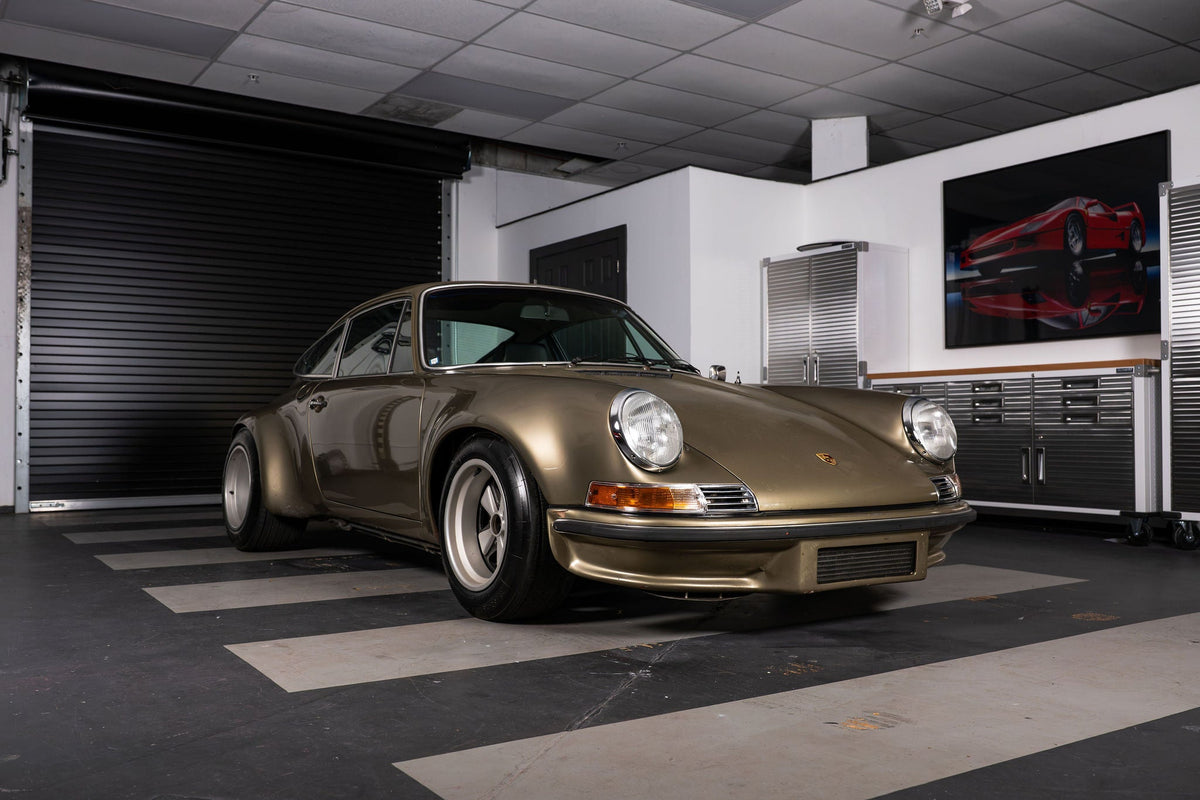
Some cars spend their lives in garages. This one spent its life in the middle of things. In more than fifty years it has worn several engines and two very different bodies, passed through the two most storied Porsche names in the American South, and turned up on a Hollywood film set. Then it crossed an ocean, passed through three countries, and found its way back to the man who had asked for the first call.

Chapter one · Jacksonville
A telex, a Volkswagen dealer and an aircraft carrier
The story starts with a man called Hubert Brundage. In 1953 he founded Brundage Motors in Jacksonville and began importing Volkswagens. Messages went by telex in those days, and every letter cost money, so Brundage Motors was shortened to Brumos, from the first letters of each word. The name stuck.
In 1958 Brundage became the Porsche importer for the south-eastern United States, and on 1 September 1959 Brumos Porsche opened as a dealership. Brundage died in a motorcycle accident in 1964. The following year the business was bought by a young racer and former naval intelligence officer named Peter Gregg.
Gregg turned a dealership into a legend, and gave it a number from the Navy: 59.Brumos, 1967
The 59 came from the hull number of the aircraft carrier USS Forrestal. In 1973 the white cars with the red and blue sweep appeared for the first time, and that same year Brumos won both the 24 Hours of Daytona and the 12 Hours of Sebring, the first of four Daytona wins for the team.

That was the world this car was born into. In 1972, at the height of the Gregg years, it was ordered new through Brumos as a 911 S, in a Paint to Sample colour rather than anything from the standard chart. The man who bought it was John Paul Sr. It still wears that colour today, and parts of the body still carry the original paint.
Chapter two · The Brumos specials
The RS America could not buy
In 1973 Porsche built the 911 that every enthusiast wanted: the Carrera RS 2.7, with its ducktail, its flared rear arches and its 2.7-litre engine on mechanical injection. Americans could not have one. The RS was never sold new in the United States.
Peter Gregg was not a man who took no for an answer. When he could not get Carrera RS cars for his customers, he offered a handful of them something of his own: a new 911 S, built up at Brumos with factory racing parts into what he promised would be every bit as good as an RS. No two were quite the same, and only around six are thought to have been built. Enthusiasts call them the Brumos specials.

If Stuttgart would not send America an RS, Jacksonville would build one.
Is this car one of them? It has never been confirmed. But everything about its first years fits: a 911 S ordered new through Brumos in the Gregg era, in a colour chosen off the standard chart, and converted to 2.7 MFI specification almost as soon as it was delivered. That is exactly the recipe of a Brumos special, and it is hard to read this car's early history any other way.

Paint to Sample
Hover over or tap any photo in this story to bring back its colour. This one matters: the shade on this car was chosen in 1972 by John Paul Sr., its original owner, from outside Porsche's standard chart, and some of that first paint is still on the body.
Chapter three · JLP
Father and son
JLP stood for John Lee Paul, and JLP Racing was a family team: John Paul Sr. and his son, John Paul Jr. The father had the money and the ambition. The son, it turned out, had the talent.

Within a few years they had built one of the most successful Porsche 935s ever raced, the JLP-3. In 1982, with Rolf Stommelen joining them, father and son won the 24 Hours of Daytona by eleven laps. Seven weeks later the same car won the 12 Hours of Sebring, the first car ever to win both in the same year. That season John Paul Jr. became the youngest champion in IMSA history. The next year, in only his fourth IndyCar start, he won the Michigan 500, passing Rick Mears on the final lap.

Away from the track, the story darkened. The JLP fortune was tied to marijuana smuggling, and John Paul Sr. had drawn his son into it as a teenager. In 1983 the father shot a witness who was due to testify against him. The witness survived, and in 1985 John Paul Sr. was convicted in federal court of attempted murder, tax evasion and drug smuggling, and sentenced to 15 years. His son was sentenced to five years in 1986, refused to testify against his father, and served about two and a half. In 2001 John Paul Sr. disappeared, wanted for questioning over the disappearance of a former girlfriend.

The son came back. He raced again, drove in the Indianapolis 500 in the early 1990s and won an Indy Racing League race at Texas in 1998, before Huntington's disease ended his career. He died in December 2020, aged 60.
Bought new by the father, it became, as his troubles grew, more and more the son's car.
Chapter four · The RSR
A 911 S that would not sit still
Whatever it was when it left Brumos, it did not stay that way. In the mid-to-late 1970s, JLP turned it into an RSR.

RSR flares and bumpers. The wide body that tells you, from a hundred yards, that this is not a road car any more.
A 3.0 RSR engine and tail. The engine and the rear wing of Porsche’s own racing 911 of the day.
Brakes from the 917. The car that gave Porsche its first overall win at Le Mans, in 1970.

Chapter five · 1981
Lights, camera, Cannonball
Here is the detail people remember. In 1981 Hollywood came to JLP Racing. The Cannonball Run, the Burt Reynolds film about an outlaw coast-to-coast road race, was partly filmed at the JLP shop, and this car appears in it, briefly, in the background of a film watched by millions of people who had no idea what they were looking at.

Chapter six · The 1990s
A getaway car
In the early 1990s Brumos fitted the car with a 964 engine. The story goes that John Paul Sr. wanted it that way for a reason: he planned to flee in it. He never did. Late in the decade he sold the car instead, to a friend, who kept it for the next fifteen years.
Chapter seven · 2012
The neighbour's car
In 2012 that friend pulled into the driveway of Vertex Auto, where Alvaro Rodriguez was working at the time. Alvaro knew him: they had been neighbours for years. But they were not close, and Alvaro had no idea he was into cars, let alone that he owned this one. All that time, it had been a few houses away.
Alvaro could not believe what his neighbour had just driven in. By the end of the day, they had made a deal.
Alvaro was not in a position to keep the car for long. When he sold it, he asked for one thing: first right of refusal. If the car was ever sold again, he wanted the first call.
Chapter eight · Three countries, three owners
The first call
The car went to Europe, and the promise went with it. Every owner after him honoured it.
In Denmark, then Holland, then Belgium, each owner picked up the phone and called Alvaro before selling. Along the way, under its European owners, it was largely returned to the way JLP had built it, and gained Öhlins suspension set up to copy the 934 and the 3.2-litre short-stroke MFI engine it still runs today. Somewhere along the way it also lost its 917 brakes; it now stops on 930 Turbo brakes.
In 2020, the third call brought it home.


Today it runs a balanced and blueprinted 3.2 with an 019 2.7 RS pump and GT2 Dougherty cams, a 915 five-speed with an oil cooler and limited-slip differential, 930 Turbo brakes and Öhlins 934 RSR-style coilovers, on 9- and 11-inch RSR-style Fuchs under JLP Racing steel flares and an IROC tail.
From the archive
Five things to know about this car
- It was ordered new through Brumos in 1972, as a 911 S in a Paint to Sample colour. It still wears that colour, and some of the original paint is still on the body.
- Its first owner was John Paul Sr. As his troubles grew, it became more and more his son John Paul Jr.'s car.
- It may be a Brumos special. It was converted to 2.7 MFI almost as soon as it was delivered, exactly the recipe of Peter Gregg's handful of RS-beaters. It has never been confirmed.
- JLP made it an RSR. RSR flares and bumpers, a 3.0 RSR engine and tail, RSR suspension and brakes from the 917. The 917 brakes were lost during its years in Europe; today it wears 930 Turbo brakes.
- It is in The Cannonball Run. The 1981 film was partly shot at JLP Racing, and this car appears briefly on screen.

The car today.
It runs a later 3.2-litre engine in place of the factory 2.4, and its replacement speedometer reads 107,086 miles, which is not a record of total distance. Cars that were raced, rebuilt and shipped across an ocean over half a century rarely keep every original part. What this one keeps is rarer: its colour, some of its first paint, and a story that runs through Brumos, a father and son, Hollywood, three countries and back to Miami.
For sale · Sunset Showroom
See it in person
This car is for sale and on display at our Sunset Showroom, 5701 Sunset Drive, South Miami. Mon–Fri 9–6 · Sat 8–1.